

Is The Genetic Makeup Called Genotype?
The genotype of an organism is its complete fix of genetic material.[1] Genotype tin can likewise be used to refer to the alleles or variants an individual carries in a particular gene or genetic location.[2] The number of alleles an individual tin can take in a specific gene depends on the number of copies of each chromosome found in that species, also referred to every bit ploidy. In diploid species like humans, two full sets of chromosomes are nowadays, meaning each private has two alleles for whatever given factor. If both alleles are the same, the genotype is referred to equally homozygous. If the alleles are different, the genotype is referred to as heterozygous.
Genotype contributes to phenotype, the appreciable traits and characteristics in an individual or organism.[3] The degree to which genotype affects phenotype depends on the trait. For case, the petal color in a pea institute is exclusively determined past genotype. The petals tin be purple or white depending on the alleles present in the pea plant.[4] Nevertheless, other traits are only partially influenced by genotype. These traits are often chosen complex traits considering they are influenced by boosted factors, such every bit environmental and epigenetic factors. Not all individuals with the aforementioned genotype look or act the same way considering advent and beliefs are modified by ecology and growing conditions. Likewise, non all organisms that look akin necessarily take the same genotype.
The term genotype was coined by the Danish botanist Wilhelm Johannsen in 1903.[5]
Phenotype [edit]
Any given factor will usually cause an appreciable modify in an organism, known as the phenotype. The terms genotype and phenotype are singled-out for at least two reasons:
- To distinguish the source of an observer's noesis (one can know about genotype past observing DNA; 1 can know about phenotype past observing outward appearance of an organism).
- Genotype and phenotype are not e'er direct correlated. Some genes just express a given phenotype in sure environmental weather condition. Conversely, some phenotypes could be the effect of multiple genotypes. The genotype is normally mixed upwardly with the phenotype which describes the end result of both the genetic and the environmental factors giving the observed expression (eastward.one thousand. bluish optics, pilus color, or diverse hereditary diseases).
A simple example to illustrate genotype as singled-out from phenotype is the bloom colour in pea plants (meet Gregor Mendel). There are three bachelor genotypes, PP (homozygous dominant ), Pp (heterozygous), and pp (homozygous recessive). All three take different genotypes just the beginning two have the aforementioned phenotype (royal) equally distinct from the third (white).
A more technical example to illustrate genotype is the unmarried-nucleotide polymorphism or SNP. A SNP occurs when respective sequences of DNA from different individuals differ at one Deoxyribonucleic acid base of operations, for example where the sequence AAGCCTA changes to AAGCTTA.[6] This contains two alleles : C and T. SNPs typically have three genotypes, denoted generically AA Aa and aa. In the example higher up, the three genotypes would exist CC, CT and TT. Other types of genetic marker, such as microsatellites, tin can have more than two alleles, and thus many different genotypes.
Penetrance is the proportion of individuals showing a specified genotype in their phenotype under a given set of environmental conditions.[seven]
Mendelian inheritance [edit]
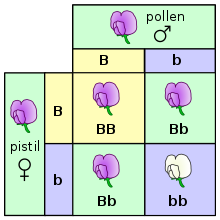
Hither the relation betwixt genotype and phenotype is illustrated, using a Punnett foursquare, for the grapheme of petal colour in a pea institute. The letters B and b stand for alleles for colour and the pictures testify the resultant flowers. The diagram shows the cross between two heterozygous parents where B represents the ascendant allele (purple) and b represents the recessive allele (white).
Traits that are adamant exclusively by genotype are typically inherited in a Mendelian blueprint. These laws of inheritance were described extensively by Gregor Mendel, who performed experiments with pea plants to determine how traits were passed on from generation to generation.[8] He studied phenotypes that were easily observed, such as constitute height, petal color, or seed shape.[8] He was able to find that if he crossed two true-breeding plants with distinct phenotypes, all the offspring would accept the aforementioned phenotype. For example, when he crossed a tall plant with a short establish, all the resulting plants would be tall. However, when he cocky-fertilized the plants that resulted, about 1/iv of the second generation would be brusk. He concluded that some traits were dominant, such as tall summit, and others were recessive, like short superlative. Though Mendel was not aware at the time, each phenotype he studied was controlled by a single factor with two alleles. In the case of plant acme, one allele caused the plants to be tall, and the other caused plants to be short. When the alpine allele was present, the plant would be tall, even if the plant was heterozygous. In order for the plant to be short, information technology had to be homozygous for the recessive allele.[8] [9]
One way this can be illustrated is using a Punnett foursquare. In a Punnett square, the genotypes of the parents are placed on the exterior. An uppercase letter is typically used to represent the dominant allele, and a lowercase alphabetic character is used to represent the recessive allele. The possible genotypes of the offspring can then be determined by combining the parent genotypes.[10] In the case on the right, both parents are heterozygous, with a genotype of Bb. The offspring can inherit a dominant allele from each parent, making them homozygous with a genotype of BB. The offspring can inherit a dominant allele from one parent and a recessive allele from the other parent, making them heterozygous with a genotype of Bb. Finally, the offspring could inherit a recessive allele from each parent, making them homozygous with a genotype of bb. Plants with the BB and Bb genotypes will look the same, since the B allele is ascendant. The constitute with the bb genotype volition have the recessive trait.
These inheritance patterns tin can too exist practical to hereditary diseases or conditions in humans or animals.[11] [12] [xiii] Some atmospheric condition are inherited in an autosomal dominant pattern, meaning individuals with the condition typically have an affected parent every bit well. A classic full-blooded for an autosomal dominant condition shows afflicted individuals in every generation.[11] [12] [13]
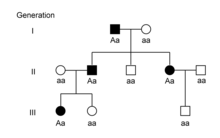
An example of a pedigree for an autosomal dominant status
Other atmospheric condition are inherited in an autosomal recessive pattern, where affected individuals do non typically accept an affected parent. Since each parent must have a copy of the recessive allele in club to have an affected offspring, the parents are referred to as carriers of the condition.[11] [12] [xiii] In autosomal conditions, the sex of the offspring does not play a role in their run a risk of existence affected. In sex-linked atmospheric condition, the sex of the offspring affects their chances of having the condition. In humans, females inherit 2 X chromosomes, one from each parent, while males inherit an X chromosome from their mother and a Y chromosome from their father. Ten-linked ascendant conditions tin exist distinguished from autosomal dominant weather in pedigrees by the lack of manual from fathers to sons, since affected fathers only pass their Ten chromosome to their daughters.[13] [fourteen] [15] In Ten-linked recessive conditions, males are typically affected more commonly because they are hemizygous, with merely 1 Ten chromosome. In females, the presence of a second X chromosome will preclude the condition from actualization. Females are therefore carriers of the condition and tin can pass the trait on to their sons.[thirteen] [fourteen] [xv]
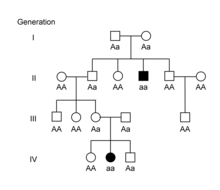
An example of a full-blooded for an autosomal recessive condition
Mendelian patterns of inheritance can exist complicated by additional factors. Some diseases evidence incomplete penetrance, meaning non all individuals with the disease-causing allele develop signs or symptoms of the illness.[13] [16] [17] Penetrance can likewise be historic period-dependent, meaning signs or symptoms of illness are not visible until later in life. For instance, Huntington disease is an autosomal dominant status, merely upwardly to 25% of individuals with the afflicted genotype will not develop symptoms until after age fifty.[18] Another factor that can complicate Mendelian inheritance patterns is variable expressivity, in which individuals with the same genotype testify unlike signs or symptoms of illness.[xiii] [sixteen] [17] For case, individuals with polydactyly tin can have a variable number of extra digits.[xvi] [17]
Non-Mendelian inheritance [edit]
Many traits are non inherited in a Mendelian fashion, but have more complex patterns of inheritance.
Incomplete dominance [edit]
For some traits, neither allele is completely dominant. Heterozygotes often accept an appearance somewhere in between those of homozygotes.[19] [20] For example, a cantankerous between true-breeding red and white Mirabilis jalapa results in pink flowers.[20]
Codominance [edit]
Codominance refers to traits in which both alleles are expressed in the offspring in approximately equal amounts.[21] A classic instance is the ABO blood group system in humans, where both the A and B alleles are expressed when they are present. Individuals with the AB genotype take both A and B proteins expressed on their red blood cells.[21] [22]
Epistasis [edit]
Epistasis is when the phenotype of one gene is afflicted past ane or more other genes.[23] This is often through some sort of masking result of ane gene on the other.[24] For example, the "A" cistron codes for hair color, a ascendant "A" allele codes for brownish hair, and a recessive "a" allele codes for blonde hair, but a dissever "B" cistron controls hair growth, and a recessive "b" allele causes baldness. If the individual has the BB or Bb genotype, then they produce hair and the hair colour phenotype tin be observed, but if the individual has a bb genotype, then the person is bald which masks the A factor entirely.
Polygenic traits [edit]
A polygenic trait is one whose phenotype is dependent on the additive effects of multiple genes. The contributions of each of these genes are typically pocket-size and add together upward to a final phenotype with a large corporeality of variation. A well studied example of this is the number of sensory bristles on a fly.[25] These types of additive effects is also the caption for the amount of variation in human eye colour.
Genotyping [edit]
Genotyping refers to the method used to determine an individual'due south genotype. There are a diverseness of techniques that can be used to appraise genotype. The genotyping method typically depends on what information is being sought. Many techniques initially require amplification of the DNA sample, which is usually done using PCR.
Some techniques are designed to investigate specific SNPs or alleles in a particular cistron or set of genes, such every bit whether an individual is a carrier for a particular condition. This can be done via a multifariousness of techniques, including allele specific oligonucleotide (ASO) probes or Dna sequencing.[26] [27] Tools such as multiplex ligation-dependent probe amplification can likewise be used to wait for duplications or deletions of genes or factor sections.[27] Other techniques are meant to assess a large number of SNPs across the genome, such as SNP arrays.[26] [27] This type of applied science is normally used for genome-wide association studies.
Large-calibration techniques to assess the entire genome are also bachelor. This includes karyotyping to make up one's mind the number of chromosomes an individual has and chromosomal microarrays to assess for large duplications or deletions in the chromosome.[26] [27] More detailed data can be determined using exome sequencing, which provides the specific sequence of all Dna in the coding region of the genome, or whole genome sequencing, which sequences the unabridged genome including non-coding regions.[26] [27]
Run into also [edit]
- Endophenotype
- Genotype–phenotype stardom
- Nucleic acid sequence
- Phenotype
- Sequence (biological science)
References [edit]
- ^ "What is genotype? What is phenotype? – pgEd". pged.org . Retrieved 2020-06-22 .
- ^ "Genotype". Genome.gov . Retrieved 2021-11-09 .
- ^ Pierce, Benjamin (2020). Genetics A Conceptual Approach. NY, New York: Macmillian. ISBN978-1-319-29714-5.
- ^ Alberts B, Bray D, Hopkin K, Johnson A, Lewis J, Raff G, Roberts K, Walter P (2014). Essential Cell Biological science (4th ed.). New York, NY: Garland Scientific discipline. p. 659. ISBN978-0-8153-4454-four.
- ^ Johannsen W (1903). "Om arvelighed i samfund og i rene linier". Oversigt Birdy over Det Kongelige Danske Videnskabernes Selskabs Forhandlingerm (in Danish). 3: 247–70. German ed. "Erblichkeit in Populationen und in reinen Linien" (in German language). Jena: Gustav Fischer. 1903. Archived from the original on 2009-05-xxx. Retrieved 2017-07-19 . . Also see his monograph Johannsen W (1905). Arvelighedslærens elementer equus caballus [The Elements of Heredity] (in Danish). Copenhagen. which was rewritten, enlarged and translated into German every bit Johannsen West (1905). Elemente der exakten Erblichkeitslehre (in German language). Jena: Gustav Fischer. Archived from the original on 2009-05-xxx. Retrieved 2017-07-19 .
- ^ Vallente, R. U., PhD. (2020). Single Nucleotide Polymorphism. Salem Press Encyclopedia of Science.
- ^ Allaby, Michael, ed. (2009). A dictionary of zoology (3rd ed.). Oxford: Oxford University Printing. ISBN9780199233410. OCLC 260204631.
- ^ a b c "Gregor Mendel and the Principles of Inheritance | Larn Scientific discipline at Scitable". www.nature.com . Retrieved 2021-11-15 .
- ^ "12.1 Mendel'south Experiments and the Laws of Probability - Biology | OpenStax". openstax.org . Retrieved 2021-xi-xv .
- ^ "iii.vi: Punnett Squares". Biology LibreTexts. 2016-09-21. Retrieved 2021-11-15 .
- ^ a b c Alliance, Genetic; Health, District of Columbia Department of (2010-02-17). Archetype Mendelian Genetics (Patterns of Inheritance). Genetic Alliance.
- ^ a b c "Mendelian Inheritance". Genome.gov . Retrieved 2021-xi-15 .
- ^ a b c d due east f g Strachan, T. (2018). Human molecular genetics. Andrew P. Read (fifth ed.). New York: Garland Science. ISBN978-0-429-82747-1. OCLC 1083018958.
- ^ a b Alliance, Genetic; Wellness, District of Columbia Department of (2010-02-17). Archetype Mendelian Genetics (Patterns of Inheritance). Genetic Brotherhood.
- ^ a b "4.iv.ane: Inheritance patterns for Ten-linked and Y-linked genes". Biology LibreTexts. 2020-06-24. Retrieved 2021-xi-xv .
- ^ a b c "14.ii: Penetrance and Expressivity". Biological science LibreTexts. 2021-01-thirteen. Retrieved 2021-11-19 .
- ^ a b c "Phenotype Variability: Penetrance and Expressivity | Acquire Scientific discipline at Scitable". www.nature.com . Retrieved 2021-eleven-19 .
- ^ Caron, Nicholas S.; Wright, Galen EB; Hayden, Michael R. (1993), Adam, Margaret P.; Ardinger, Holly H.; Pagon, Roberta A.; Wallace, Stephanie East. (eds.), "Huntington Disease", GeneReviews®, Seattle (WA): Academy of Washington, Seattle, PMID 20301482, retrieved 2021-xi-19
- ^ "Genetic Dominance: Genotype-Phenotype Relationships | Larn Science at Scitable". www.nature.com . Retrieved 2021-11-15 .
- ^ a b Frizzell, Thousand.A. (2013), "Incomplete Authority", Brenner'southward Encyclopedia of Genetics, Elsevier, pp. 58–threescore, doi:10.1016/b978-0-12-374984-0.00784-1, ISBN978-0-08-096156-9 , retrieved 2021-eleven-15
- ^ a b Xia, X. (2013), "Codominance", Brenner's Encyclopedia of Genetics, Elsevier, pp. 63–64, doi:10.1016/b978-0-12-374984-0.00278-iii, ISBN978-0-08-096156-nine , retrieved 2021-11-15
- ^ "Genetic Authorization: Genotype-Phenotype Relationships | Learn Science at Scitable". www.nature.com . Retrieved 2021-11-xv .
- ^ Gros, Pierre-Alexis; Nagard, Hervé Le; Tenaillon, Olivier (2009-05-01). "The Development of Epistasis and Its Links With Genetic Robustness, Complexity and Drift in a Phenotypic Model of Adaptation". Genetics. 182 (1): 277–293. doi:ten.1534/genetics.108.099127. ISSN 0016-6731. PMC2674823. PMID 19279327.
- ^ Rieger, Rigomar. (1976). Glossary of genetics and cytogenetics : classical and molecular. Michaelis, Arnd,, Green, Melvin M. (fourth completely rev. ed.). Berlin: Springer-Verlag. ISBN0-387-07668-9. OCLC 2202589.
- ^ Mackay, T. F. (December 1995). "The genetic basis of quantitative variation: numbers of sensory bristles of Drosophila melanogaster as a model system". Trends in Genetics. 11 (12): 464–470. doi:10.1016/s0168-9525(00)89154-4. ISSN 0168-9525. PMID 8533161.
- ^ a b c d Jain, Kewal One thousand. (2015), Jain, Kewal Thousand. (ed.), "Molecular Diagnostics in Personalized Medicine", Textbook of Personalized Medicine, New York, NY: Springer, pp. 35–89, doi:x.1007/978-1-4939-2553-7_2, ISBN978-ane-4939-2553-7 , retrieved 2021-eleven-xix
- ^ a b c d e Wallace, Stephanie East.; Edible bean, Lora JH (2020-06-18). Educational Materials — Genetic Testing: Electric current Approaches. University of Washington, Seattle.
External links [edit]
 | Wikimedia Commons has media related to Genotypes. |
- Genetic nomenclature

Is The Genetic Makeup Called Genotype?,
Source: https://en.wikipedia.org/wiki/Genotype
Posted by: smelleywhatinat.blogspot.com
0 Response to "Is The Genetic Makeup Called Genotype?"
Post a Comment