

Did Bette Davis Really Do Her Own Makeup On Human Bondage
Hair studies would be remiss in overlooking Bette Davis's contrarian, Gilded Age, Hollywood mane. Off-screen, the actress was celebrated for her outdoorsy New England look, sports dress, and self-styled locks. Merely Bette Davis's on-screen tresses in the years between 1942 and 1962 did more than than simply mirror Hollywood's unfolding archive of white female person beauty. Her hair frequently flouted the aesthetic norms of classical Hollywood cinema, in ways that assistance us see her ain auteurism. Davis'south look evolved, simply what endured was her unique cinematic signature. And unsurprisingly, with her hair, every bit well every bit her physical gestures, this actress so well known for representing the contortions of white feminine green-eyed and ability has much to teach us about racial feeling in America during the Golden Age.
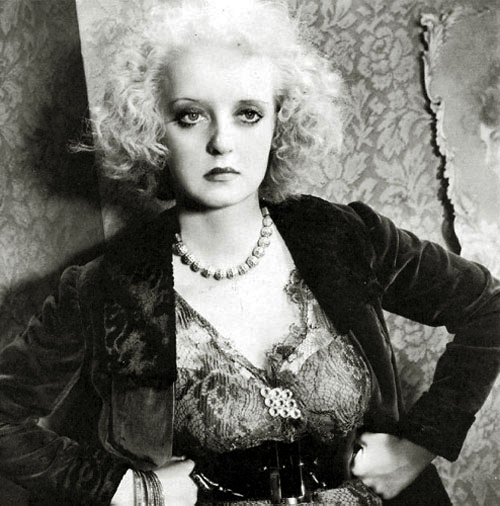
Davis in Of Homo Bondage (1934), as dying Mildred, with freaked out bob
That Davis was the czar of her onscreen epitome is indisputable: on the set of The Private Lives of Elizabeth and Essex (1939), she defied managing director Michael Curtiz by insisting on retracting her hairline, shaving it dorsum six inches. The star was determined that the studio'south elaborate red wig would not hide what she envisioned was the aging queen'southward balding pate. This was non her sole moment of "meddling." Davis seized the reins from the studio's hair and makeup departments on several boosted pictures, The Little Foxes, Mr. Skeffington, and What Always Happened to Baby Jane. Expressing disdain for Method Acting in the 1950s, Davis claimed that she worked similar Laurence Olivier, from the outside in. Bespoke pilus and excessive whiteness became her auteurist language for signaling the dangers of racial animus and gender inequality. Despite Davis'southward integration of the Hollywood Canteen during WWII, and her career-long mentoring of Blackness actors, the star'southward commitments to social justice plant a trivial-known dimension of her legend.
That Bette Davis'south pilus contributed to how she challenged norms of feminine beauty is well established. Now, Voyager offers a case written report. A mother-tormented spinster lets her hair down so that, healed by the talking cure, she tin put it support again, on her ain terms. The actress'south range, depth, and sprezzatura in the 1941 melodrama were virtually unmatched, salvage perhaps in Dark Victory, her personal favorite. Davis's on-screen hair in Voyager was front and center, but virtually famously, it was obscured, forth with her pensive, quietly radiant, face, half shaded by a glorious Panama lid. In the scene recording her physical transformation, early in the film, the camera did an ascending blazon, focusing on spectator pumps, silk-stockinged legs, chic adapt, shadowed face, and upswept pilus. Coming to rest on Charlotte'south broad-brimmed lid, the viewer followed the heroine as she descended the bounding main liner gang plank to embark on a new life.

In brief moments beyond the remainder of the film, Davis, known for her hyper-embodied gestures, deftly worked lacquered fingernails over a series of glittering hat pins, projecting her heroine's new-establish competence. The reborn, masterful Charlotte, now an heiress, took her place at the patriarchal table. That this was achieved by sacrificing her chance for romantic love and sexual satisfaction is the bailiwick of a vast feminist critical bibliography inaugurated by Teresa De Lauretis, Maria De Laplace, and Lauren Berlant, most recently joined by Angelica Jade Bastien and Briallen Hopper.
Along with Now, Voyager'due south focus on Charlotte'southward metamorphosis, I am fascinated past Davis'southward self-mutilating hairdo in the 1942 stealth Race movie, In This Our Life. Based on Ellen Glasgow's Pulitzer Prize winning novel of 1941, information technology features a secondary civil rights plot that gave the volume its progressive aureola. Davis played Glasgow's villainess, Stanley Timberlake, who stole her sis's husband, collection him to suicide, killed a kid, and maimed her mother in a drunken striking and run. In her final show of treachery, Stanley framed for her own crimes the African American Parry, gifted son of the family unit housekeeper (Hattie McDaniel. The aggressive Black youth had risen from chauffeur to store clerk to legal apprentice to George Bent. Stanley ranked on par with the Niggling Foxes Regina Giddens, who denied lifesaving heart medication to her dying hubby, and Baby Jane Hudson, who starved and tortured her own sister to death in Baby Jane.

John Huston'south movie remains critically disregarded, despite James Baldwin'southward brilliant analysis of it in The Devil Finds Work. Baldwin saw the motion picture twice at age eighteen: in one case uncut in a picture palace on Broadway and 42nd Street; and once again, in Harlem, where Black actor Ernest Anderson's antiracist soliloquy, which he wrote himself, had been expurgated for its purported potential to incite African American audiences. The Production Lawmaking's censors feared that "Negro" viewers would identify with Parry's scathing critique of the antiblackness at the heart of the American justice system. Those scenes were also removed in the Due south, though Black troops at training camp, Ernest Anderson among them, saw the unedited film and requested that the histrion'due south screed exist replayed several times.
Might a hairdo communicate racial animus? What about a style? In the actress'due south more famous villainous roles — Little Foxes and Baby Jane — Davis sported a veritable whiteface mask, a expect that she devised and insisted on, to the horror of Foxes managing director William Wyler. In Foxes, Davis's graphic symbol and her brothers were associated with the New S's exploitation of Black workers; in Baby Jane, Davis played a demented ex-child star who blamed their Black housekeeper and her paralyzed sister for planning to cashier her in an institution. Jane ended up hammering to death the African American Elvira and trussing upwardly paralyzed sibling Blanche in a scene evocative of a lynching, crimes redolent of white supremacist terrorism.
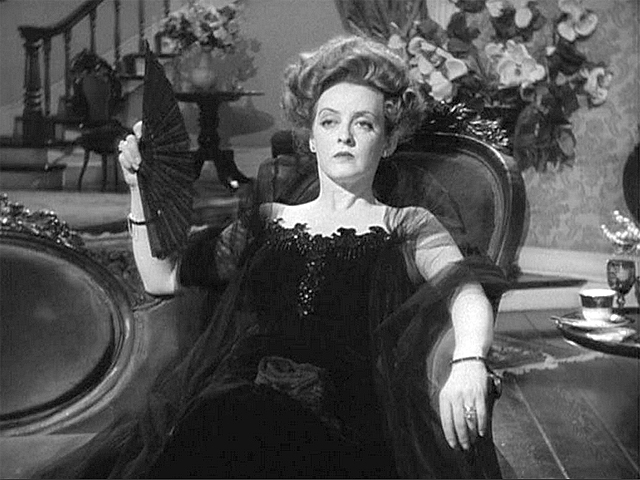
For Life, Davis determined that her heinous character had to look sleazy to stand out amid the frumpy early 1940s fashions past which she was surrounded. Her on-screen sister Roy (Olivia De Havilland) wore upswept hair and drab suits. Stanley was clad in flashy synthetic dresses, far shorter than Roy's skirts, and provocative open-toed shoes that seem to beckon to be removed. Davis concocted a ghastly hairstyle to convey this tacky sensibility, cutting her own bangs as might a four-yr-quondam child who's discovered the contraband family scissors; she also styled garish waves and a flipped silhouette that consistently repelled test audiences. Distressed over the negative feedback nerveless from theaters in Pasadena and Fifty.A., the extra came to agree with these early on spectators, finding her own look so lamentable that she never viewed the film again.
The graphic symbol of Stanley powerfully illustrated the racism itinerant in the 1940s. Her sordid artful telegraphed immorality, while the botched haircut was a sign of bad organized religion. That Glasgow (who wrote the screenplay) and Huston'southward villainess carried a racial prejudice so deep every bit to ruin the life of an exceptional family protegee makes a statement about white American attitudes toward Blackness life at the dawn of WWII. Toward the finish of the war, African American leaders had hoped that Black participation and sacrifice in Europe and the Pacific would compel white politicians to desegregate the military. This only happened belatedly, in 1948, three long years after the German and Japanese surrenders. It is my sense that although the racially progressive Davis played such a monster ("those people all lie for each other," she complained to sister Roy when Parry's female parent provides him with an alibi), she may accept been less than thrilled past the ease with which her character destroyed a promising Black life. Peradventure Davis's self-dressing-down for her expect in Life was a displacement for her political ambivalence about playing a drastic racist on screen.
This was not Bette Davis's final operation as a racist. Nosotros don't know whether, in imagining What Ever Happened to Baby Jane (1960), Henry Farrell was knowing or oblivious in his cribbing of Harriet Beecher Stowe's fiddling Eva graphic symbol, the doomed celestial child who seeks to finish slavery in Uncle Tom's Motel. On her deathbed from consumption (exacerbated by her horror of human bondage), Stowe'south Eva evangelized her ain bondspeople with locks of her own aureate curls. Such was Stowe'south sacramental vision, her notion that abolitionism would exist a salvage for the shattering nation.
When director Robert Aldrich brought Baby Jane to the screen, Farrell's antislavery iconography migrated with the novel. (Farrell wrote the screenplay with Howard Koch). The young actress avatar of Bette Davis's adult protagonist was dressed in Eva-esque white and lace, sporting aureate curls. Performing on the Vaudeville phase in 1917, she evoked in her audience a sympathetic filiopiety, as she sang of her lost father, to whom she had been devoted.
Bette Davis's on-screen pilus in Infant Jane was linked to the original sin of slavery, the buoy of abolition, and the Myth of the Lost Cause. This southern ideology denied the significance of black bondage as the inciting reason for the Civil War. White women curated the memory of the heroic Amalgamated Expressionless, while erasing the centrality of race-based oppression in their moonlight and magnolias version of history. Developed Infant Jane sported a terrible wig of long golden curls and a white infant-doll wearing apparel replicating her girlhood costume. She also groomed the curly blond hair of her three-quarter-sized Baby Jane doll, the doppelgänger that her father had hawked on stage during Vaudeville days. Jane devotedly brushed, ribboned, and cooed to the creepy doll with a tenderness never displayed toward sis Blanche, or housekeeper Elvira.
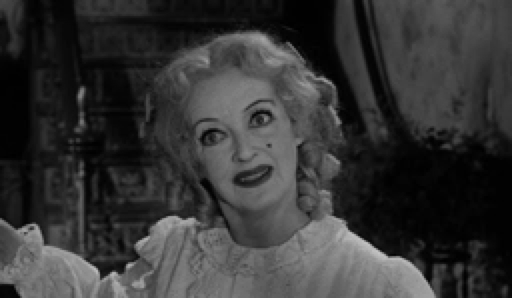
Bette Davis as Infant Jane Hudson, echoing Harriet Beecher Stowe's Little Eva
Forth with Davis's "pilus" in the film came her as political, always-whitening visage. In another autuerist moment, without consulting director Aldrich, the actress decided that she wanted Jane's face to exist masklike. Collaborating with Perc Westmore, who had been Davis'due south makeup man for 20 years, the 2 concocted a paste that she applied to her face every 24-hour interval of filming. The result was a mien that seemed to reflect archeological time, as Davis refused to launder off the white layers for the entire 28-day shoot.
The wait they created conjured portraits of pre-revolutionary French aristocrats, with powdered faces and blackness beauty spots, which Davis likewise wore. Decadent and reactionary, Baby Jane was herself a deposed blueblood of the Vaudeville stage. The character perceived a mortal enemy in the family's clear Black housekeeper. Elvira supported sis Blanche'southward desire to put Jane into a "home"; and in a fascinating aside, we learned that she wanted "to see a man nearly jury duty." Actress-racial activist cum auteur Maidie Norman created that line to replace Farrell'southward original racist language, which Norman described every bit hailing from "slavery times." One time connected to a Picayune Eva's centrality to abolitionist literature, Baby Jane's faux gold curls and bleached visage had come to telegraph white supremacy.
The auteurist theory of bully male person directors, derived from studying figures like Hitchcock, Truffaut, Bergmann, and John Ford, has remained compelling to some in picture palace studies. But materialist flick scholars have argued that auteurism has failed to account for the vast numbers of artists, craftspeople, and technicians required to create a motion picture show. The category can be recuperated, notwithstanding, when practical to sure performers. Bette Davis was an extra-auteur. She imagined her characters in highly physical means, which led to the disobedience of directors, writers, and occasionally herself, in the case of In This Our Life. Appropriately, attention to Bette Davis'southward contrarian, classic Hollywood pilus provides access to the social and political vision behind the operation for an actress who claimed devotion to the surface of her characters, just who instinctively loved their depths.
Julia Stern is Charles Deering McCormick Professor of Educational activity Excellence and Professor of English at Northwestern University and the author of Bette Davis Blackness and White (Chicago UP, 2022).
Atomic number 82 Epitome: Bette Davis portrait by George Hurrell, 1938.
Source: https://avidly.lareviewofbooks.org/2022/01/13/bette-daviss-hair/
Posted by: smelleywhatinat.blogspot.com
0 Response to "Did Bette Davis Really Do Her Own Makeup On Human Bondage"
Post a Comment